In a continent with high income inequalities where most of the population is the below the poverty line, the only thing that mitigates the class structure is Education. Education by its nature gives an equal footing because the children of the poor and the rich to level up in terms of the meritocracy to access jobs and the opportunities that would not be accessed otherwise.
Long ago when I did sociopolitical commentary, this is what I wrote “Just had an interesting discussion with a friend about this poster. She is bothered that a University student is holding up a poster with such glaring spelling error and lack of proper punctuation. My analysis of the poster was very different. When I looked at this, I immediately believed that this is not a spelling error done unaware, but is part of the symbolism of this message itself. It is basically saying that for as long as education remains exclusive in a developing nation, only a few will benefit and others will be unable to cope, because we have moved from an industry-based to a knowledge-based economy. So those who do not access education will not be literate and will be unable to do as basic a thing as writing/spelling.”
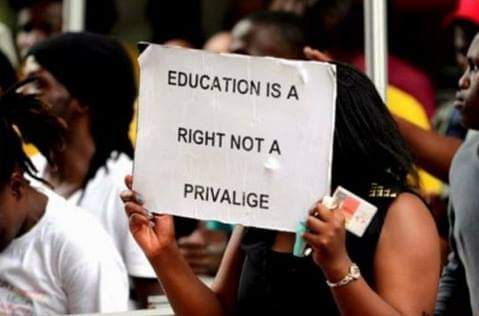
Education is another site that the youth must claim. Perhaps the most important. Through the demands of institutional transformation and the opening of doors of learning, we must design an education system truly geared towards an auto-centric African developmental agenda. We have an obligation to fashion a higher civilisation. It begins with being able to self-critique and to be honest about ourselves as a people.
The biggest tragedy about our education system however is that it treats students as if they have a uniform way of learning. It fails to take into consideration the fact that there is no one universal application of teaching that can cater to students’ learning differences. Some students’ learning style is auditory, they understand better when a teacher explains to them as opposed to when they have to read through a textbook. Some students are visual learners, they understand better when they look at graphics, demonstrations or read from textbooks. Some learners are kinaesthetic, they understand better when they do practical work. What this means is that if a kinaesthetic learner is placed in a classroom where they are forced to learn by listening to a teacher, they will most likely under perform. The same would happen if a visual learner were forced to be auditory. This is what the education system of our country does: it judges fish by their ability to cycle.
 Mwene
Mwene 